Dive Gear · Explainer
One Question.
One Answer.
Focused, self-contained articles that answer a single dive gear question with precision. No jargon that isn't explained. No padding. No upsell. Just the answer you came for.
Each article covers exactly one question.
Each answer is grounded in the Gear Science.
Each Explainer links to the deeper treatment for divers who want more.
The Explainer Format
Why one question at a time?
Dive gear questions often look simple but open into complex physics. "DIN or A-clamp?" is really a question about engineering standards, pressure ratings, and your specific diving context. An Explainer holds the boundary — one question, fully answered, with a clear path to more depth if you want it.
01
The question, stated plainly
Every Explainer opens with the exact question a diver might search for — not a paraphrased version of it, and not an academically precise reformulation of it.
02
The answer, grounded in physics
The answer is based on the same scientific principles that underpin the Gear Science articles — but distilled to exactly what is needed to answer this specific question.
03
The deeper treatment, if you want it
Every Explainer ends with a link to the relevant Gear Science article — for divers who want the full physics, the full decision matrix, or the full specification framework.
The Complete Library
All five explainers
?
Explainer · No. 01
DIN or A-Clamp — Does It Actually Matter?
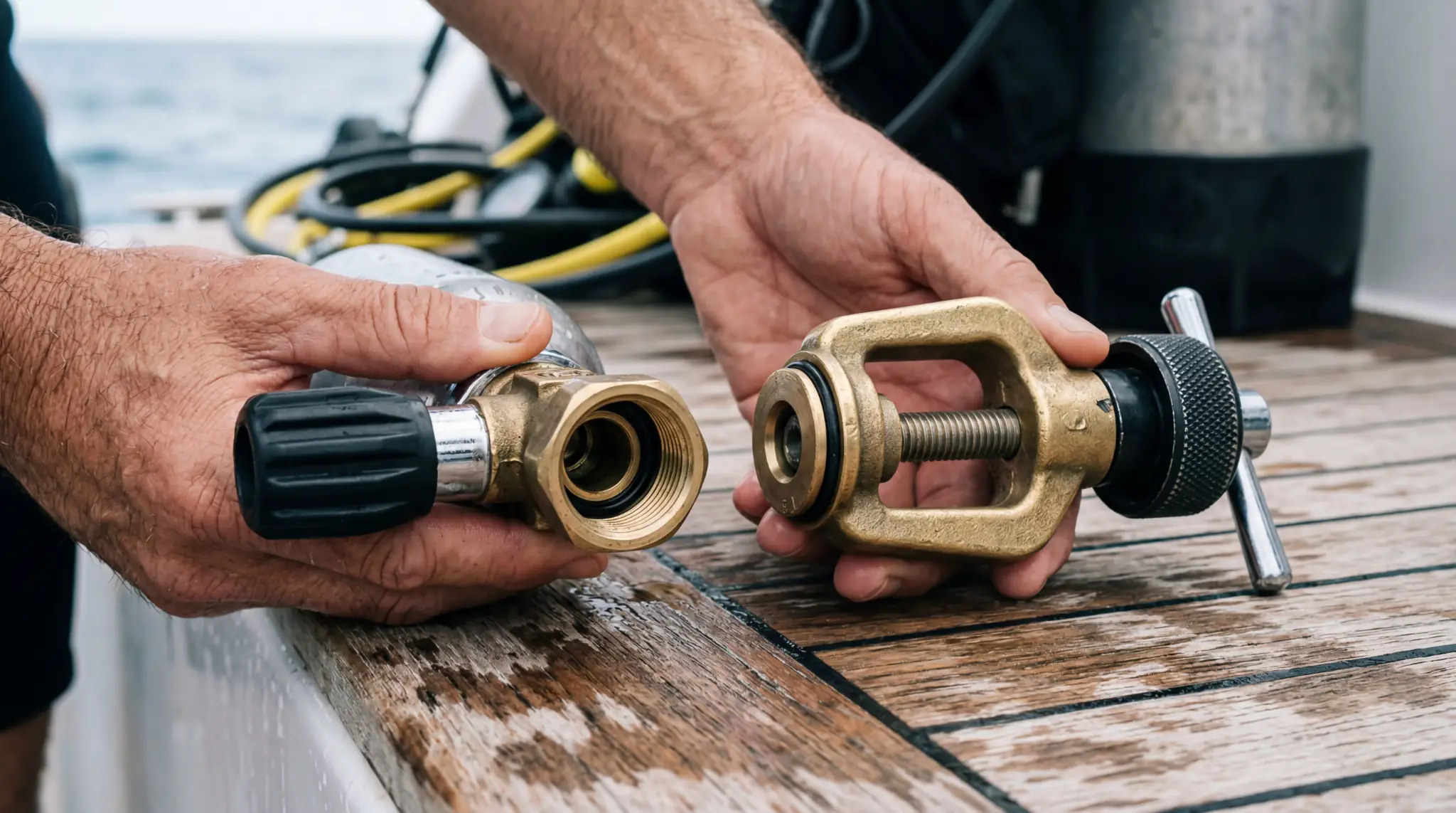
The mechanical difference between DIN threading into the valve body and an A-clamp clamping over the valve face. Pressure ratings, O-ring protection, DIN vs A-clamp in different diving contexts, and a clear decision framework for choosing between them.
Read the Explainer →
→
?
Explainer · No. 02
Wetsuit Thickness — What the Numbers Actually Mean
What 3mm, 5mm, and 7mm represent in terms of thermal protection. How neoprene compression at depth changes those numbers significantly. Which thickness is appropriate for which water temperature range — and why the answer changes as you go deeper.
Read the Explainer →
→
?
Explainer · No. 03
What Does Balanced Mean — and Why Does It Matter at Depth?
What the word balanced actually refers to inside a first stage — the valve force geometry that makes cylinder pressure irrelevant to breathing effort. Why an unbalanced regulator breathes progressively harder as the cylinder empties, and why that compounds at depth. A depth-and-pressure table showing where the gap opens. The difference between a balanced first stage and a balanced second stage.
Read the Explainer →
→
?
Explainer · No. 04
What Is Cracking Effort — and How Do I Know If Mine Is Good?
Cracking effort defined precisely in cmH₂O — the minimum inhalation force required to open the demand valve. The acceptable range (1.0–2.5 cmH₂O), what poor cracking effort feels like at depth, and why it matters for gas efficiency. A five-step surface self-assessment you can perform without specialist equipment. The Venturi lever — related but different. What to tell your service technician.
Read the Explainer →
→
?
Explainer · No. 05
What Is a Semi-Dry Suit — and Is It Worth the Extra Cost?
How a semi-dry reduces water flushing through sealed wrist, ankle, and neck seals — and why flushing is a wetsuit's primary thermal weakness. A three-way comparison: standard wetsuit, semi-dry, drysuit. The temperature table showing where each suit type is appropriate. Four verdict boxes — when the extra cost is worth it, when it depends, and when it is the wrong tool entirely. What to check in seal construction and seam type before buying.
Read the Explainer →
→