
2,250
Metres
The Deepest Mind
The Sperm Whale · Physeter macrocephalus
The deepest-diving mammal. The loudest animal ever measured. A brain that has been thinking underwater for 23 million years longer than ours has existed.
A sperm whale surfaces, breathes for eight minutes, then dives. Not to 30 metres where you dive. Not to 100 metres where the technical divers push. It goes to 2,250 metres — nearly 2.3 kilometres below the surface — where the pressure exceeds 225 atmospheres, the temperature is 2°C, and absolute darkness has existed since before complex life evolved on land.
It stays down for up to 138 minutes. On one breath.
The sperm whale does not merely survive these conditions. It navigates them. It hunts in them. It uses sound to see in them — producing clicks so powerful they are the loudest biological sound ever measured on Earth. Then it rises, breathes, and does it again.
Everything about this animal is an exercise in extremes so far beyond mammalian norms that researchers spent decades arguing about whether the physiology was even possible. It is. And understanding how illuminates principles that every diver who has ever studied gas physics will find immediately recognisable — and deeply surprising.
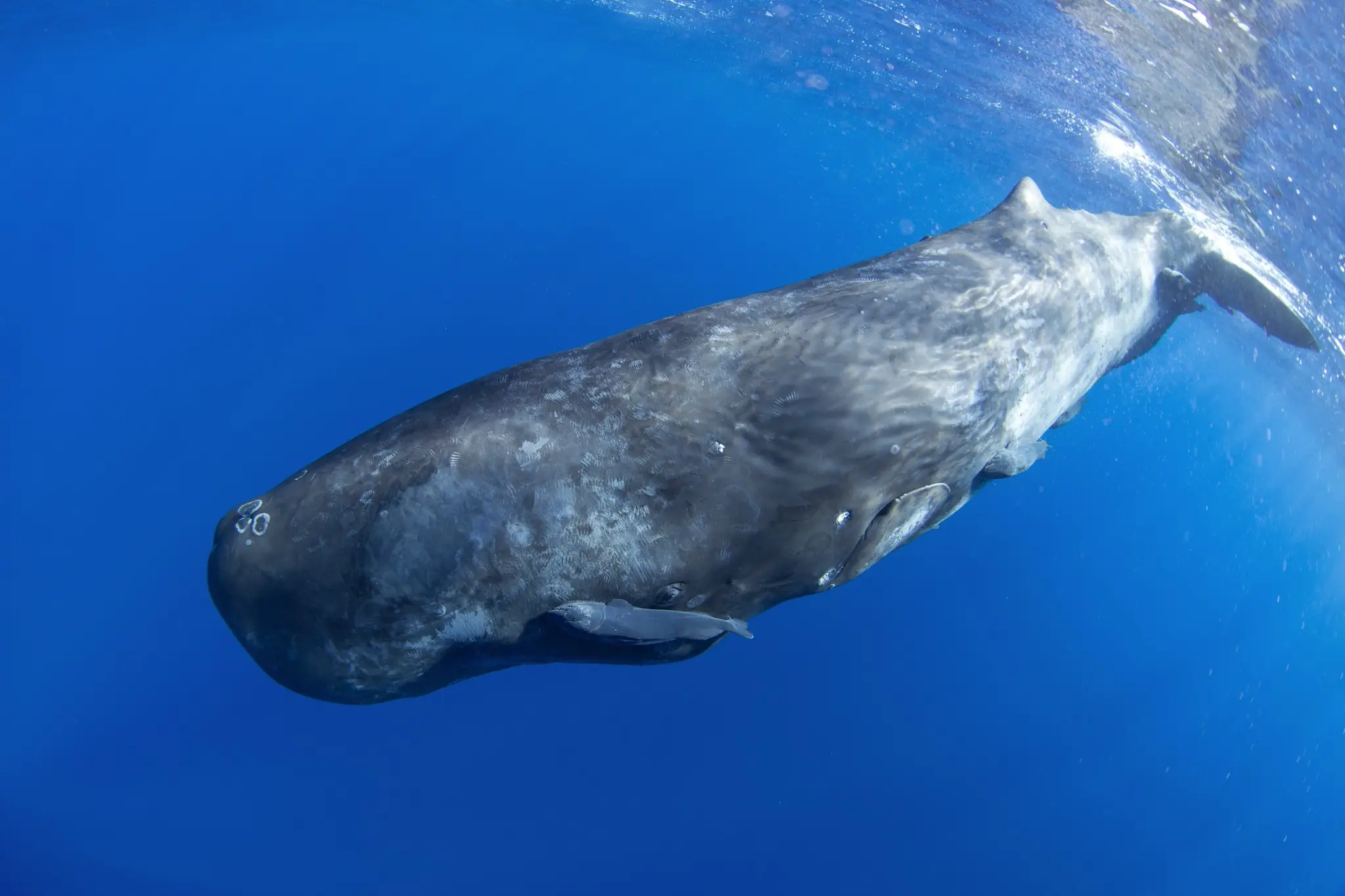
A human diver breathing compressed air at 40 metres risks nitrogen narcosis. At 60 metres, oxygen toxicity becomes lethal without a helical gas mix. The physics of gas under pressure governs everything we do underwater. The sperm whale appears to ignore all of it.
It does not. It has solved the same problems through 30 million years of evolution — and the solutions are more elegant than anything in a dive computer.
* The absolute depth record belongs to the Cuvier's beaked whale at 2,992 metres. The sperm whale holds the record among toothed whales with active echolocation hunting systems. Both will be the subject of Deep Brief editions.
At around 200–300 metres, the sperm whale's lungs collapse entirely. This is intentional and essential. A collapsed lung cannot absorb nitrogen into the bloodstream — which means no narcosis, no oxygen toxicity at depth, and no nitrogen loading that would require decompression stops on ascent. The chest wall folds inward without injury. The whale's oxygen supply is not primarily in its lungs anyway — it is stored in the blood and muscle.
The sperm whale's head constitutes up to one-third of its total body length and roughly one-third of its body mass. In an 18-metre adult male, this means a head the size of a city bus. That head is not skull — it is an acoustic organ of extraordinary complexity.
The click is produced in a highly specialised nasal complex: a pair of phonic lips fires a pulse of sound that bounces off the spermaceti organ — a massive, oil-filled case — then off the skull, through the junk (a second acoustic lens of waxy tissue in the forehead), and out into the ocean as a focused beam. The returning echo is received through the lower jaw and routed to the inner ear through fatty acoustic waveguides.
At 236 decibels, this is a sound intense enough to stun prey at close range. Researchers have documented giant squid with apparent acoustic trauma. Whether incapacitation is deliberate or an incidental effect of echolocation is still debated. The whale's own tissues are shielded by an isolation system we do not yet fully understand.
The spermaceti organ holds up to 1,900 litres of oil in a large adult male — a quantity that represents a significant fraction of the animal's total buoyancy. The organ was the reason the whaling industry killed over a million sperm whales in two centuries. Whalers called it "spermaceti" because they mistook the white, waxy oil for seminal fluid.
Its acoustic amplification role is now well-established. But the leading secondary hypothesis is buoyancy regulation: by controlling blood flow through the organ's elaborate vascular network, the whale cools the oil to increase its density and reduce lift on descent, or warms it to decrease density and assist ascent — effectively fine-tuning its position in the water column with minimal energetic cost. A diver's equivalent would be a BCD that adjusts itself using body heat rather than air.
The supporting evidence is indirect but compelling: the vascular system is inconsistent with purely acoustic function; the oil changes density meaningfully across the achievable temperature range; and the energetics of deep diving make some form of buoyancy assistance almost necessary for the observed dive profiles. But direct measurement of spermaceti temperature changes during a wild dive has never been achieved. The head of the largest toothed predator that ever lived still holds an unanswered question.
Sperm whale encounters occur almost exclusively at the surface. The whale has just completed a dive of 45 to 138 minutes to depths you will never reach with any equipment, and it is now recovering — processing oxygen debt, replenishing myoglobin stores, and preparing for the next descent. The animal floating almost motionless is not resting the way a sleeping human rests. It is engaged in a physiological reset of considerable complexity.
The social structure you are observing when you encounter a group is a matrilineal unit — typically 10 to 15 females and their young, led by the oldest female. Adult males live largely solitary lives at higher latitudes, joining female groups only to mate. The animals you see together are almost certainly related — sisters, daughters, grandmothers — maintaining bonds that researchers have documented across decades.
A behaviour divers sometimes witness is "logging" — a group of whales floating motionless at the surface in parallel, occasionally touching. This is not sleep in the REM sense. Sperm whales appear to experience a form of slow-wave sleep while drifting vertically in the water column, sometimes with the rostrum pointing downward. Both forms appear necessary for healthy physiological function.
Responsible encounter protocols exist for a reason beyond etiquette. Sperm whales are individually catalogued by researchers who identify animals by fluke shape, scarring patterns, and click dialects. An encounter that causes a whale to abort its surface recovery phase — through vessel noise, diver proximity, or drone harassment — imposes a genuine metabolic cost on an animal whose energetic budget for deep diving is finely balanced. The whale you encounter may be known to researchers. It may be a grandmother with a documented history going back to the 1980s. Treat it accordingly.
The sperm whale brain weighs approximately 7.8 kilograms — nearly six times the mass of a human brain, and the largest of any animal known to have ever lived on Earth. Mass alone does not determine cognitive capacity, and by the encephalisation quotient the sperm whale is not in the same range as humans or dolphins. But the neocortex is elaborately folded — a surface area architecture associated, across species, with complex social cognition — and the structures dedicated to acoustic processing are without equivalent in the animal kingdom.
What that brain is doing has occupied cetacean researchers for decades. The most significant finding is not about intelligence in the abstract. It is about culture — in the technical scientific sense. Culture requires social learning: behaviours transmitted between individuals by observation and imitation, not by genetics. Sperm whales demonstrably possess it.
A language, in the linguistic sense, requires: a finite set of units that combine productively to generate a large or infinite set of meanings; a grammar governing combination; and reference — the capacity to denote things in the world. Whether sperm whale codas meet these criteria is actively investigated and genuinely unresolved.
What is established: codas are combinatorial — individual rhythmic patterns are combined into sequences; they are learned and transmitted socially, not genetically encoded; different clans maintain different coda repertoires across generations; individual whales can be identified by coda characteristics; and codas appear in social contexts rather than foraging contexts, suggesting social communication rather than navigation.
Project CETI — the Cetacean Translation Initiative — is currently applying large-scale machine learning to a library of sperm whale vocalisation recordings to determine whether the combinatorial structure reaches the complexity required for linguistic classification. The answer is not yet known. Which is itself a remarkable sentence to write about any non-human animal.
The matriarch of the group you encounter carries decades of knowledge: where prey concentrations appear in different seasons, how to navigate between feeding grounds, which clan members she has known since birth. Individual sperm whales are catalogued globally — identified by fluke shape, scar patterns, and the acoustic signature of their codas. Some animals in active research populations have documented histories stretching back forty years. They are not anonymous wildlife. They are known individuals with accumulated life histories.

In 1851, at the height of the industrial whaling era, Herman Melville described the sperm whale's forehead as "dead, impenetrable" — a blank wall of matter.
We now know that behind that wall is the most elaborate social acoustic communication system in the ocean, a memory capable of recognising individuals across decades, and a brain navigating the deep in matriarchal family groups for 23 million years longer than anatomically modern humans have existed.
The animal Melville's industry hunted to near-extinction was, by any reasonable definition of the word, a person.
When you are in the water with one, you are not observing an animal.
You are a guest, briefly, in a society.